
Have you ever looked at the swollen, twisted veins on someone’s legs and wondered why they showed up there? Age, pregnancy, and weight explain a lot. But a large Stanford Medicine study, published in Circulation on September 24, 2018, points to something nobody expected. Your height may play a part. Taller people, the researchers found, are more likely to develop varicose veins.
What the Stanford team actually did
Researchers led by Nicholas Leeper, MD, and Erik Ingelsson, MD, PhD, used data from the UK Biobank, a genetic repository holding records on about half a million people. They analyzed data from 413,519 participants using machine learning and standard epidemiological methods. For the genetic portion, they ran genome-wide association studies on 337,536 of those people, and 9,577 had varicose vein disease. Refer here for more details.
The machine learning model was given 2,716 possible predictors and asked to identify the strongest ones. No hypothesis steered it. “You could say that you turn the machine loose on it,” Ingelsson said. Height rose to the top, catching the team off guard.
Height looks like a cause, not a coincidence
A link on paper does not prove much, so the researchers tested it further using Mendelian randomization, a statistical technique for assessing cause and effect. The results strongly suggest that height is a cause of varicose veins and not merely a bystander. Genes that predict how tall a person grows may be the same genes tied to the condition. Leeper said this could point toward new ways to treat it.
The scan also flagged bioimpedance, a measure of how well the body resists electric current, as a strong predictor. It could eventually become a diagnostic tool.
The risk factors we already knew
The study confirmed the established list. Being older, female, overweight, or pregnant raises risk. So does a history of deep vein thrombosis, leg surgery, a family history of the condition, smoking, hormone therapy, and lack of movement. The link with clots runs both ways, Leeper noted. A past clot raises your odds of varicose veins, and varicose veins may raise your odds of a clot. The team also found a strong genetic correlation between the two conditions and identified 30 genomic regions associated with varicose veins.
Why this matters for varicose vein treatment
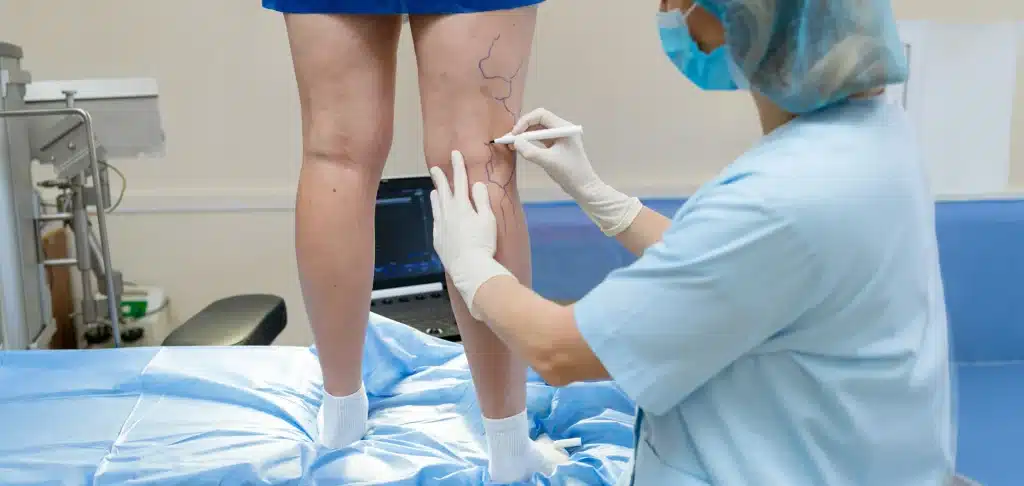
More than 30 million people in the United States have varicose veins. Many wave them off as a cosmetic issue, yet they can cause real pain. Lead author Alyssa Flores put it bluntly: shockingly little is known about its biology, and no medical therapy can prevent or reverse the condition. Current varicose vein treatment is mostly procedural, such as laser treatment or vein stripping. The genes this study uncovered could become targets for drugs that do not exist yet. That gap matters. Surgery and laser work, but they treat veins that have already failed. A drug that targets the biology earlier could change what care looks like for millions of people.
Where varicose veins recurrence fits in

This study did not measure recurrence, so no one should read it as a prediction about your own results. Still, it raises a fair question. If inherited biology drives the condition, then fixing one vein may not change the underlying tendency. Knowing which genes and traits underlie varicose vein recurrence could help future researchers design follow-up plans tailored to each person.
Living with a higher risk
If you are tall, you cannot change that, and the study gives no reason to panic. You can still act on the factors within your control. Move your legs often, especially during long stretches of sitting or standing. Keep a healthy weight and avoid smoking. Talk with your doctor if you take hormone therapy or have a history of clots. Walks help. So does elevating your legs at the end of a long day. Neither cures the condition, but both ease strain on your legs.
Pay attention to varicose veins after treatment, too. Swelling, heaviness, or fresh bulging veins months later deserve a call to your doctor, because varicose veins after treatment can mean the condition is still active. An early checkup is simpler than waiting for pain to return.
Get your legs checked
Advanced Cardiovascular Center offers evaluation and care for varicose veins. If you have leg pain, swelling, or visible veins, you can learn more at https://www.advancedcvcenter.com/varicose-veins/ and talk with a specialist about your options.